Tech Page

Last Updated: Sunday, February 3rd 2013 at 6:34 PM

MSA – Tech Changes

MSA – Changes this year

CKC – Blackbushe FAQ

For those of you that haven’t had a chance to read the new Blue and Gold books for 2011, here are some of the key changes for 2011 as well as some amendments since these were published.

For questions related to the following please contact:

Keith Ramsbottom on: 07771 555990

(posted 3rd Feb 2011) To all 250 National Drivers
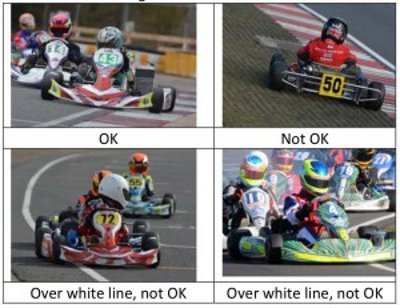
Please note that front bumpers must have the attachments of the lower bar parallel in both the horizontal and vertical planes.  The attached images show both a legal and illegal front bumper.  Please note that the karts will be checked for compliance at the next meeting.  Thank you for your attention to this matter.
Regards
Graham Smith, Secretary, SKRC

IllegalLegal

Tyre Changes

Please note the following changes from Vega’s to Mojo’s for the Rotax classes in 2011
Quote from the 2011 year book:
D1.7 Tyres.
Dry: MOJO D1 marked ‘CIK-H’ with ‘YELLOW’ barcode
10.0 x 4.50-5 front. 11.0 x 7.10-5 rear.
Wet: MOJO W2 marked ‘CIK’ with ‘YELLOW’ barcode
10.0 x 4.50-5 front. 11.0 x 6.00-5 rear
Dry: VEGA SL8 marked ‘J.A.G.’ 10 x 4.50-5 front, 11 x 7.10-5 rear tyres are permitted at Club meetings  only until 01.03.2011
CKC winter championship regs state:
3.1 Eligible Vehicles
All karts must comply with MSA Kart General, Technical and safety regulations and class regulations within the MSA kart race yearbook applicable at the time of that round of the Championship.
Summary
In January and February 2011 either the Vega SL8’s or the MOJO D1’s slicks can be used in dry conditions.
From the first of January 2011 only MOJO W2’s can be used in wet conditions.
From the 1st of March MOJO wets and slicks must be used. Vega slicks will no longer be permitted.

Class Age Changes

Cadet Class
15.1. Class for 8-13 year-olds.
15.1.1. A Competitor may continue in the Class until 31st December in the year of their 13th birthday, but may not move up before their 11th birthday.
15.1.3. Having moved into a Junior class, they may not revert to Cadet

Junior Classes.

15.2. A Novice (14.1.2) Competitor may enter the Junior Class from their 11th birthday and continue until 31st December in the year of their 17th birthday.

Technical Changes

Bodywork and Bumpers
17.1.1. All bodywork fitted to short circuit karts (with the exception of pre 2011 homologated Cadets) must be
CIK Crash-Tested and Homologated, with the sole exception of the rear protection. CIK Crash-Tested and
Homologated bodywork that expired in 2008 may continue to be used. CIK Crash-Tested and Homologated ‘Mini Kart’ bodywork is mandatory for the Cadet and Super Cadet Classes for newly homologated chassis from 1st January 2011 (refer to Cadet and Super Cadet Class regulations for specific dimensions).
Cadet
B1.3.5 Bodywork and Bumpers. All Cadet karts must be fitted with bumpers and bodywork providing front, rear and side protection, as detailed in the regulations below and in Drawing Number 6 in Section U of the MSA Competitors’ and Officials’ Yearbook. CIK Crash-Tested and Homologated Minikart bodywork may also be used.
B.1.3.7 Rear Bumper. Must comply with U17.8.4-17.8.8, and the following:
• Consist of two horizontal tubes. The upper having outer extension forming a closed loop, with two link tubes to the chassis anchorage points (as per Drawing 5, Diagram 2 in Appendix 1 of Section U) at least 450mm apart at any point. The radius of the outer extensions is free but it should not be less than 21⁄2 times the tube outside diameter.
• Have the upper bar and outer loops constructed from magnetic steel tubing with a minimum outside diameter of 18mm and a minimum wall thickness of 1.4mm.
• Have the lower bar constructed from magnetic steel tubing with a minimum outside diameter of 15mm and a minimum wall thickness of 1.4mm.
• Have the upper tube and uppermost extension element 225mm } 25mm above the ground in dry configuration.
• Have the lower tube connected between the two uprights and a maximum height of 100mm above the ground in dry configuration and a minimum height level with the centreline of the chassis rail.
• Have the lower tube secured at all times if bolted.
B.1.3.9 Side Pods. Must comply with U17.10 and the following:
• Include on the outer side a vertical surface with a minimum height of 70mm and a minimum length of 250mm located immediately above the ground clearance.
• Not include holes or cuttings except those necessary for their attachment and those in the inside and top plastic face for fitments (maximum M8 diameter). A hole may also be drilled for starter access, even if not in use.
• Not cover any part of the driver seated in their normal driving position.
• Not be designed to hold back water, gravel or any other substance.
• Have a clearance of between 25mm and 60mm above the ground in dry configuration (see Section U, Drawing 6).
B.1.3.10 Front Fairing. Must comply with U17.5.1-17.5.3 and the following:
• Have a width of 850mm } 150mm.
• Have a front overhang of 500mm maximum.
• Have a clearance of between 25mm and 60mm above the ground in dry configuration (see Section U, Drawing 6).
• Comprise on its front face a centrally located vertical surface minimum 250mm x 70mm. Or be an approved design specifically permitted by the MSA.
B.1.3.11 Front (Nassau) Panel. Must comply with U17.6.1, 17.6.2, 17.6.4, 17.6.5, and the following:
• Have a maximum width of 300mm.
• Be fixed behind the front bumper and must not protrude past the front face of the front fairing.

Rotax Classes

D1.4.4 Intake Silencer. Only Type 2 may be used.
The Intake Silencer/Airbox must be used unmodified as supplied by Rotax for the FR125 Max engine with its filter and all component parts including support bracket in place.
The two halves of the airbox must be securely screwed together using 4 M6 screws. All 4 screws must be sufficiently tightened to securely clamp the two halves of the airbox together.
In all conditions the air box MUST be positioned with inlet trumpets to the bottom of the box. The air box must be securely fitted in a manner to prevent rotation.
D1.4.7 Ignition Unit. DENSO digital battery ignition, variable timing with no adjustment. Ignition coil must have “129000-“ and “DENSO” moulded on the case. The ignition coil must have three pin connection. The ignition coil must be mounted by means of two original rubber mounting blocks or equivalent to the gearbox cover. In the case of chassis component interference with the original mounting position it is permitted to relocate the ignition coil by the use of an extension bracket. The extension bracket must be attached to the original gearbox cover mounting holes. The minimum length of HT lead permitted is 210 mm from outlet of cable at ignition coil to outlet of cable at spark plug connector (= the visible length of wire). Spark plug cap must be marked with “NGK TB05EMA”.
Ignition switch can be either On-Off type, part number 265592, or Automatic fuse type, part number265590.
Any make of battery is permitted provided it is of the same specification as supplied by Rotax for the FR125MAX 12v/6.5Ah, 12V/7.2Ah or 12v/9Ah. FIAMM-GS type FG20651, FG20722,
FGHL20722, FGH20902 ,YUASA YT7B-BS and ROTAX BATTERY FX7-12B recommended. Only lead acid gel batteries are permitted. The pick up must be marked with the numbers 029600-0710, followed by a variable production code on the 2nd line.
D1.5 Transmission. Direct from the engine to the rear axle via a single length of chain. The clutch must be as supplied by Rotax for the FR125 MAX. The internal running surface of the clutch must remain dry and free of grease or lubricant or any additional substance. The engine clutch must be triggered at 4000 rpm maximum and make the kart and Driver move forward. The clutch must be in direct drive (and 100% engaged) at 6,500 rpm. See U18.8. A bar test may also be used to test clutch engagement, parameters to be advised.
All sprockets must use a 15 x 19 x 17 needle cage bearing and O-ring seal except in the case of an 11 tooth sprocket. An 11 tooth sprocket must be fitted with a plain bearing and O-ring seal.

MiniMax

D4.8.3 Weight: Minimum of 135kg including driver at all times. Maximum kart weight without driver is 99kg.
D4.8.5 Age: From 11th birthday to 31st December in the year of 15th birthday. As per U15.2.

Junior

D1.8.2 Weight. Minimum of 148kg including driver at all times. Maximum kart weight without driver is 108kg.
D1.8.4 Age. Year of 13th birthday to 31st December of the year of 17th birthday. Drivers who have not reached their 13th birthday must provide evidence that they have held a National A licence for at least 12 months prior to  competing in this class.

Senior

E1.8.2 Weight: Minimum of 162kg including driver at all times.
E1.8.5 Age: The class is open to any driver aged 16 or over. A junior may transfer to this senior class at any time during the year that he/she achieves their sixteenth birthday, subject to U15.2.1 of the MSA Competitors’ and Officials’ Yearbook. Having moved into the senior class he/she may not revert to a junior class.

250 Gearbox

F3.7 Wheels and Tyres. Limited to 5in or 6in diameter wheels with a maximum tyre width of 8in. Open or control tyre(s) may be specified in ABkC/BSA championship regulations.
Short Circuit: Both rear outer rims must incorporate bead retention comprising three pegs at equidistant positions. This is applicable to both wet and dry tyres. Radial tyres are not permitted.
Slick: Open to any freely available commercially recognised type of tyre from Bridgestone, Dunlop or Maxxis, only complete sets of the same type of tyre is permitted. Only one set of slick tyres is permitted per race meeting (not including official practice) except where a tyre is damaged beyond use as determined by the Chief Scrutineer, one extra front and one extra rear may be allowed. It is the competitor’s responsibility to make sure the Scrutineer inspects a faulty tyre before the kart leaves the track exit/weighing in area.
Wet: Open to any freely available commercially recognised type of tyre from Bridgestone, Dunlop or Maxxis, only complete sets of the same type of tyre is permitted.

TKM

D3.3.14 Use of CIK homologated crash tested bodywork consisting sidepods, a front fairing and Nassau panel is mandatory and must conform to MSA Competitors’ and Officials’ Yearbook regulations. A CIK rear protection system is not permitted. The sidepods should be a matching pair of same homologation on either side and the front fairing and Nassau should also be a pair from same homologation, but those two sets of body pairs can be from different homologations. It is permitted to modify the bodywork mounting points on the chassis to accept CIK crash tested bodywork but it must be undertaken in a professional manner. Karts homologated for the class and made in the period up to 2006 where they are fitted with a traditional front bumper incorporating two vertical front uprights are permitted to make use of the CIK front fairings without the CIK associated metalwork. In this case, as long as the two vertical uprights remain in place, the requirement for a securing block as per MSA Competitors’ and Officials’ Yearbook regulations is waived and the fairing may be attached to the kart by any safe and secure method in two places, not necessarily the CIK type clips. TKM homologated karts for the period up to 2006 inclusive with old style diagonal bar fixing points may use side bumpers with a minimum of one tube with a minimum size of 18mm diameter (19/20mm recommended) and a wall thickness of 1.4mm minimum securely fixed to the chassis by a minimum of two points on each side and must allow for the attachment of mandatory side bodywork. The plastic elements of the bodywork must be CIK crash tested and homologated as per MSA Competitors’ and Officials’ Yearbook regulations but the sidepods must be of the fully enclosed type with closed ends.
Sidepods may incorporate suitable holes for starter shaft, airbox trumpet, etc where MSA Competitors’ and Officials’ Yearbook regulations permit. When wet weather tyres are fitted, it is permitted for the wheels and tyres to be inside the sidepods, so long as the sidepods have closed solid ends.

Weights

D3.4.10 Senior and Junior weight/restrictor sizes as follows, In each case the weight is total of driver and kart as raced. Restrictor sizes quoted are maximum diameter permitted: Junior 123 kilos with black anodised 19.5mm restrictor. Junior 128 kilos with Gold anodised 20.5mm restrictor. Junior 135 kilos with Blue anodised 22mm restrictor. Junior 142 kilos with Purple anodised 24mm restrictor. Junior 148 kilos no restrictor required.
Senior 146 kilos with Blue anodised 22mm restrictor. Senior 152 kilos and Senior Extreme Clubman 165 no restrictor required.
D3.8.2 Weight (on completion of any part of the event)
Junior TKM 123: min 123kg with driver. Maximum kart weight without driver is 86kg
Junior TKM 128: min 128kg with driver. Maximum kart weight without driver is 86kg
Junior TKM 135: min 135kg with driver. Maximum kart weight without driver is 86kg
Junior TKM 142: min 142kg with driver. Maximum kart weight without driver is 83kg
Junior TKM 148: min 148kg with driver. Maximum kart weight without driver is 81kg
Junior TKM Extreme: min 138kg with driver. Maximum kart weight without driver is 92kg
Senior TKM Extreme 146: min 146kg with driver.
Senior TKM Extreme 152: min 152kg with driver. The driver must, in full racing equipment, weigh a minimum of 68kg at all times.
Senior TKM Extreme Clubman: min 165kg with driver. Drivers must be aged over 35 years and/or the driver must in full racing equipment weigh a minimum of 80kg.
D3.4.28 The use of both piston rings in the 100cc engine is mandatory. The rings must at all times remain predominately free (50% or more) to operate in the manner in which they were designed and supplied. It is the responsibility of the driver to ensure that the rings are not ‘coked’ in place with carbon or prevented from their normal ‘spring’ effect by other methods. The rings should be appropriate to the piston size used and have a maximum ring gap of 0.5mm when measured with the ring placed squarely 5-10mm down from the top of the cylinder bore. On Extreme engines the same rule applies to the one ring fitted.
D3.8.4 Ages/Sizes
Junior TKM – From 11th birthday. As per U15.2. Minimum driver weight in full race gear to be 38kg. Minimum driver height wearing race boots but no crash helmet nominally 135cm.
Junior Extreme – From 13th birthday to 31st December of the year in which 17th birthday falls.
10.3.1. Standards. Helmets bearing one of the under mentioned ‘standards’ may be approved by the MSA
subject to other criteria being met.
(a) INTERNATIONAL EVENTS & ALL MSA EVENTS.
FIA 8860-2004.
SNELL SA2010.
SNELL SA2005.
SNELL SA2000*.
HELMET  REGS FOR 2011
SNELL SAH2010.
SFI Foundation 31.1A, 31.2A.
BS 6658 Type A/FR**.
*May be withdrawn with effect from 01/01/15.
**May be withdrawn with effect from 01/01/16.
(b) In addition the following are acceptable for:
International and MSA National Kart Racing Events (with exception of International Kart Drivers under 15 years of age and Cadet/Bambino Drivers*):
• SNELL K98 and K2005
• SNELL K2010
• SNELL – FIA CMR2007
• SNELL – FIA CMS2007
International Kart Drivers under 15 years of age and Cadet/Bambino Drivers. The weight of the helmet may be checked at any time during an event and must not weigh more than 1,550g:
• SNELL – FIA CMR2007
• SNELL – FIA CMS2007
*From 1st January 2011 all Cadet drivers require the Snell – FIA CMR2007/CMS2007 helmet standard.
From 1st January 2013 all National Kart Drivers under 15 years of age will require the Snell – FIA
CMR2007/CMS2007 helmet.
Note: Snell standards can be verified by either a self adhesive label or a cloth label. The self adhesive label has a silvered background and the cloth label will approximate to the colour chart on page 178.
Part of the approval procedure is to affix an MSA sticker to the outside of the helmet in the approximate location of the driver’s right ear.
Stickers may only be affixed by selected scrutineers, by the MSA at Motor Sports House, MSA approval stickers, for which a fee of £1.70 is charged, are printed on foil, and once individually affixed, cannot be reapplied. Note: Stickers supplied since 01/01/08 are individually numbered.
Helmets approved for use in all disciplines require a blue MSA sticker to be affixed. Helmets which are accepted for use in kart racing only require a green or yellow where applicable MSA sticker to be affixed.
These stickers are available from issuing scrutineers.

ApprovedHelmet standards